Montana Judge Weighs Voter Rules for Students in College Towns
A state judge blocked a new Montana residency restriction after a lawsuit filed by student advocates, leaving prior registration rules in effect for the midterms.
By Sanjay Ivanov ·
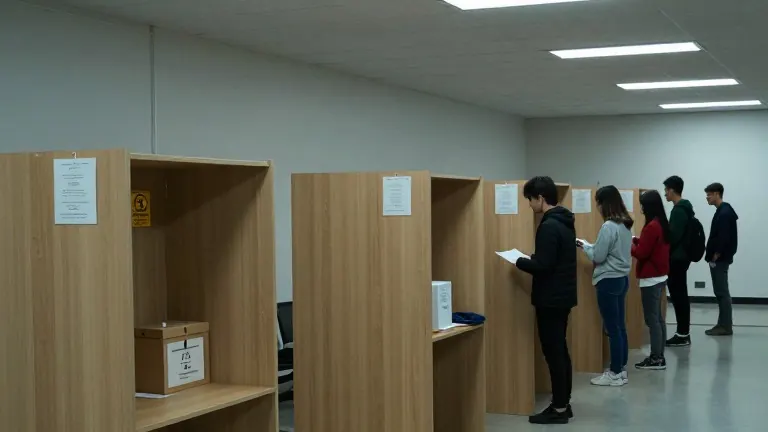
A Montana judge blocked a new state law this month that would have restricted where college students can register to vote, keeping the previous rules in place for the midterm elections through Election Day. Missoula County Judge Jason Marks held a hearing earlier in October and is preparing a final ruling in the lawsuit brought by the Montana Public Interest Research Group, or MontPIRG.
The dispute centers on a restriction passed last year by Montana's Republican-controlled legislature for what the law describes as "temporary" residents in an "educational program." Under the revised rules, such residents could register in a Montana county only if they intend to make that county or the state their permanent home once the program ends.
GOP state officials argue the restriction does not apply to students at Montana colleges and universities. In a court filing, they wrote that applying the restriction that way "would render the word 'temporary' meaningless, because no one understands obtaining a two, four, or eight-year degree as a temporary endeavor." Marks found in February that the restriction likely violates Montana's constitution and declined to accept the state's interpretation for now.
MontPIRG claims the residency rule change could force thousands of students to lose the ability to vote on how their communities are run. In Montana, a U.S. citizen who is 18 or older and has been a state resident for at least 30 days is generally eligible to register to vote there.
The case returns to a question that has circulated since a 1979 Supreme Court ruling affirmed that eligible students may register in the communities where they live during the academic year. Voting in the United States is tied to residency, and state and local governments determine who qualifies as a resident able to register.
Michael Hanmer, a professor of government and politics at the University of Maryland whose research has focused on student voters, said federal law sets ground rules for residency requirements so that certain voters, including eligible students, are not discriminated against. "You can't apply different standards to different groups of people, so college students need to be treated the same as anybody else in the mix here who might be new to a particular place," Hanmer said.
Yael Bromberg, an attorney who co-edited the book Youth Voting Rights: Civil Rights, the Twenty-Sixth Amendment, and the Fight for American Democracy on College Campuses, described the legal concept of domicile as "the one singular, fixed, permanent, principal home where one intends to return, although she may not currently reside there." For a student who does not know where they will live after graduation, Bromberg said, that determination is "highly personal and an individualized assessment."
Hanmer said he would be surprised if the Montana restriction holds up in court. He also noted that some states require a new resident to obtain a state ID or change a car registration. "They can impose these restrictions," Hanmer said, "but they impose them on all new residents, not just college students."
At a public hearing last year, some supporters of the restriction said students from outside Montana should not be able to affect the state's elections. Marks is preparing his final ruling after the October hearing.
Source: KPBS