Midterm Outlook: Democrats Lead Generic Ballot by Eight Points Among Likely Voters
A new poll shows a narrowing enthusiasm gap among key demographic groups, suggesting the Democratic wave may be smaller than historical averages indicate.
By Sanjay Ivanov ·
A new poll conducted Oct. 19 and 20 indicates that Democrats hold an eight-point lead on the generic congressional ballot among likely voters. The survey, commissioned by NPR, PBS News, and Marist, polled 1,289 registered voters with a margin of error of plus or minus 3.8 percentage points for likely voters. This lead positions Democrats as favorites to win control of the House, though the margin is smaller than the double-digit leads seen in previous midterms where the party gained more than 30 seats.
President Trump’s approval rating among likely voters stands at 40 percent, with 59 percent disapproving. Among registered voters, the disapproval rate is higher at 61 percent. The gap between the two groups suggests that the most engaged voters are slightly more favorable toward the president than the broader electorate. However, 53 percent of both registered and likely voters said they strongly disapprove of his job performance, a figure that ties the highest level recorded in the poll last month.
Historically, a lead of this size on the generic ballot has translated into significant seat gains for Democrats. In 2018, the lead was seven points, and in 2006, it was 12 points. In both cycles, Democrats flipped at least 30 seats. This time, structural changes may limit those gains. Recent redistricting efforts, including mid-decade map changes requested by President Trump and subsequent adjustments by Democrats, have tilted the map in the Republicans’ favor.
Enthusiasm levels present a mixed picture for the Democratic Party. Democratic likely voters are 10 percentage points more likely to report high enthusiasm for voting compared to Republicans. However, key demographic groups that have driven recent Democratic wins show lower enthusiasm. Only 42 percent of likely voters under 45 and 56 percent of white women with college degrees said they are very enthusiastic about voting. In contrast, 68 percent of MAGA voters and 66 percent of white women without degrees reported high enthusiasm.
Voters across the spectrum identified cost of living as their primary concern. A third of respondents said they have experienced financial hardship in the past year, and 4 in 10 said their personal finances have worsened. Shun Maurice, a 47-year-old independent from Arizona who leans Democratic, cited high food and gas prices as the main driver of his vote. He stated that prices are too expensive for everyone, regardless of who they voted for.
Immigration remains a top issue for self-described MAGA supporters, while preserving democracy resonates most with Democrats and independents. On the generic ballot, 55 percent of likely voters said it is more important to elect candidates who will bring change. Chris Agan, a 43-year-old Democrat in Tyler, Texas, described the current election as a referendum against the party in power. He is supporting James Talarico in the state’s U.S. Senate race, citing a slow decline in the state’s standard of living.
Trump is not on the ballot, but his influence remains evident. Forty-four percent of likely voters said their vote is against Trump, compared to 21 percent who said it is for him. Some swing voters, however, are wary of the Democratic Party’s shift toward democratic socialism. Matthew Schroder, a 38-year-old independent in Charlotte, North Carolina, said he opposes that direction and is supporting Republican Michael Whatley over Democrat Roy Cooper in the state’s Senate race. He noted that his vote is not solely against Trump but against the party’s current trajectory.
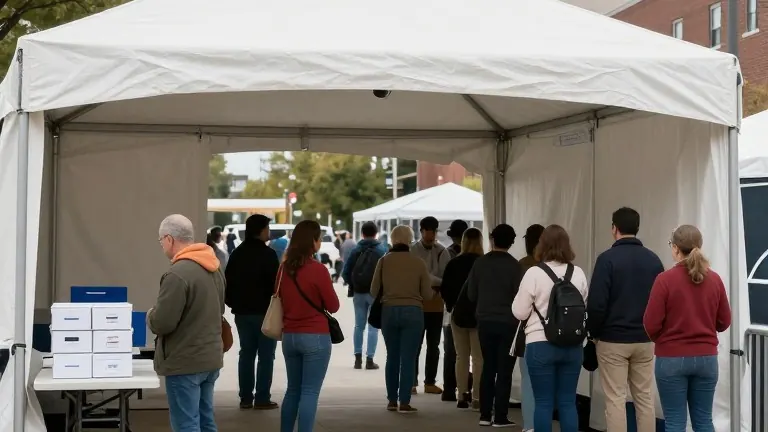
Confidence in the election process is high, with 75 percent of likely voters stating that state and local governments will run a fair and accurate election. Democrats show the highest confidence at 88 percent, while Republicans stand at 68 percent. A larger gap appears in willingness to accept results. Seventy percent of Republicans said their preferred candidate should accept the outcome, a 20-point difference from Democrats. MAGA supporters were twice as likely as democratic socialists to say their candidate should challenge the results if they lose.
Other issues show sharp divides. Six in 10 likely voters believe new data center construction will negatively impact the country, with 66 percent opposing a data center in their own community. On immigration, 61 percent of voters said immigrants should have a legal path to stay if they meet requirements, while two-thirds of Republicans said they should be required to leave. Government efficiency remains a dividing line, with 57 percent of voters calling government wasteful and inefficient, a view shared by majorities of Republicans and independents.
Source: KPBS